



Billing-Related Questions
1. What do all the numbers and charges mean on my bill?
Click here to see an example of a bill and how to read it.
2. What is facility charge on my bill?
A facility charge is a monthly charge that Big Country Electric Cooperative (BCEC) members pay to help cover the basic cost of bringing electricity to their location. It covers some of the expenses the cooperative incurs regardless of how much electricity is sold. Because all cooperative members benefit from having reliable electric service available when they need it, the facility charge allows everyone to pay their share of the basic costs.
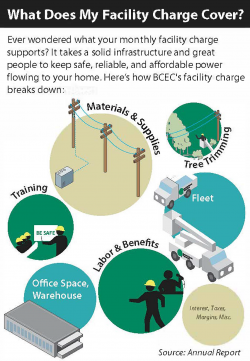
We evaluate what it actually costs BCEC to serve each member, giving consideration to the various types of electric service needed by our members - residential, commercial, industrial, farm, seasonal, or irrigation, etc., as cost and requirements vary depending on the type of service. Additionally, there are fixed costs associated with maintaining electric service to a location regardless of whether it consumes electricity or not. These fixed costs tend to be higher in rural areas such as ours, primarily because our population density is lower and there are fewer meters per mile. For example, BCEC averages 2.4 meters per mile; in more populated areas such as the Metroplex, some utilities may average 3 to 4 dozen meters per mile and can spread fixed costs out among more consumers.
BCEC serves a diverse membership. Some of our members use a lot of electricity all year long, and some may use electricity only one or two months per year. Whether you use a lot or a little, the cost of getting electric power to your location remains the same. And that is why your electric bill has two separate charges: the facility charge to cover basic costs, and the per kWh charge for the actual amount of electricity consumed.
We hope this brief explanation helps answer your questions about the facility charge portion of your electric bill. Please call us if you have any billing questions.
3. What is the Power Cost Adjustment charge and why does it change each month?
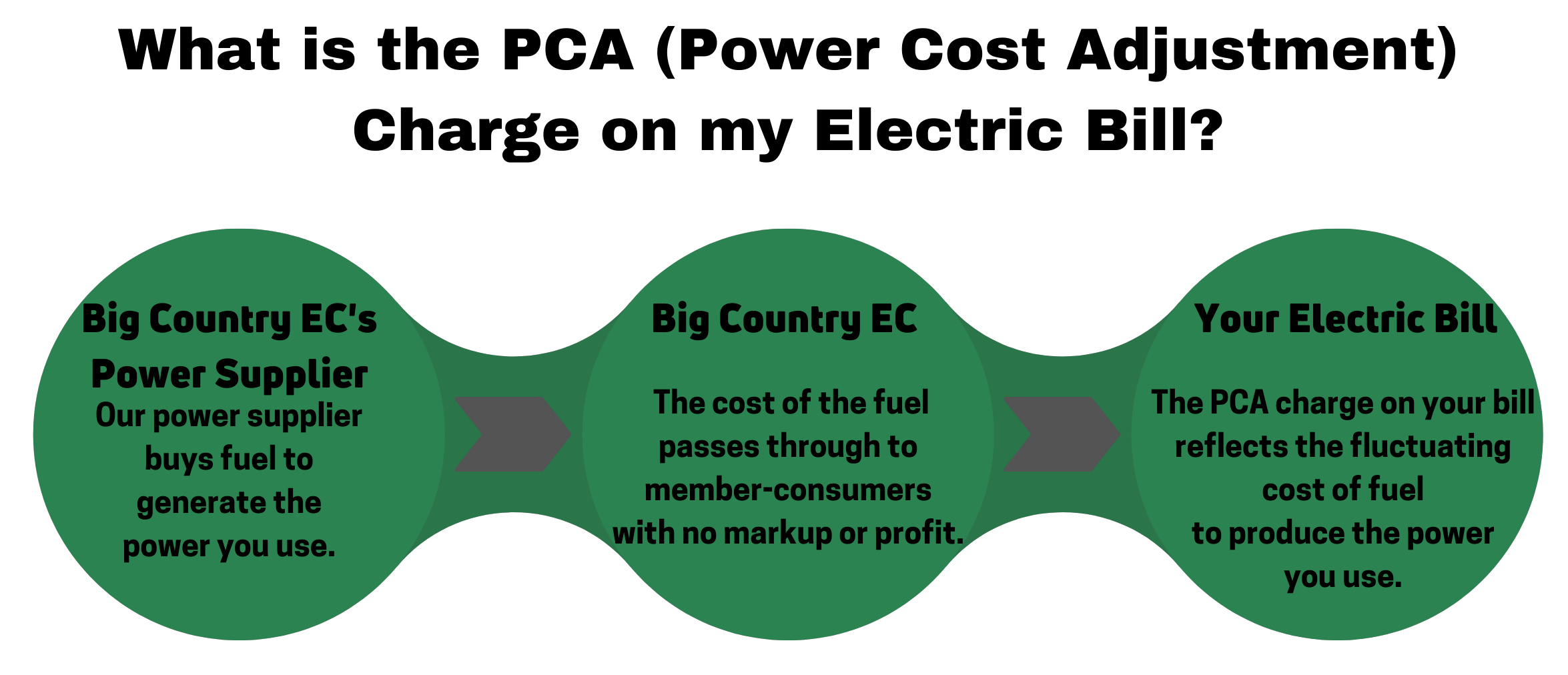
The Power Cost Adjustment (PCA) is the rate component on electric bills that is based on our average expected/budgeted purchased power cost of $0.06 per kWh – this is what we pay for the electricity we buy on your behalf. The exact cost varies somewhat from month to month, which is why we base our rate on the average just mentioned. BCEC’s rate is $0.099665 per kWh; the difference between that and the cost of purchased power – about $0.039665 per kWh - is what we operate on. While BCEC’s kWh rate has not changed, members may pay more as the PCA increases to manage higher-than-budgeted cost of purchased power. To minimize the impact of this charge on our members, the PCA is analyzed monthly and every attempt is made to “level” it, rather than to pass on possible extreme monthly fluctuations from our wholesale supplier, and to be more responsive to changes in fuel costs. BCEC will continue to monitor the cost of generating electricity and may adjust the PCA as necessary.
4. Not sure how the Demand Charge works on your BCEC Commercial Account? View our guide to understanding demand charges.
5. Do I have unclaimed Capital Credits? Click here to see!
6. Where can I access information about residential solar?
The Public Utility Commission of Texas (PUCT) has published a consumer guide to help members better understand residential solar.
View the PUCT Residential Solar Guide
You can also learn more about how solar works within Big Country Electric Cooperative’s system, including costs, considerations, and tools to help determine if solar is right for you.
Visit BCEC’s Solar Information Page
Large Electric Loads (“Mega Loads”)
As electric demand grows across Texas, utilities across the state — including electric cooperatives — are receiving requests from very large power users such as data centers or industrial facilities. These types of projects are often referred to as “mega loads.”
Here are a few quick facts about how these requests are handled and what they mean for our members.
1. How BCEC evaluates requests for high-demand electric service (mega loads)
Electric cooperatives are required to provide service fairly and without discrimination, meaning BCEC cannot refuse a consumer based solely on electrical volume or demand. However, very large projects — such as data centers or major industrial facilities — go through a far more extensive technical, engineering, risk assessment, and regulatory review process than a typical residential, agricultural, or small commercial service request. Because of their size, these loads require additional studies and requirements to help ensure the electric system can safely and reliably support the requested load, as well as established member loads, before a project can move forward.
2. How do you make sure the electric system can support a large facility?
Before any large facility can be energized, projects are carefully examined at the local, regional, and state levels to evaluate their potential impact on the electric system. These reviews include detailed cooperative engineering analysis as well as broader transmission and grid-level studies coordinated through ERCOT. Projects must meet all system requirements and reliability standards before they can move forward.
3. Do large facilities still have to follow BCEC’s service requirements?
Yes. Large facilities must adhere to the cooperative’s terms and conditions of service, which include requirements designed to ensure reliability standards and cost responsibilities are met. These provisions help protect the integrity of the electric system and ensure fair treatment for all consumers.
Providing service without discrimination is one of the core principles of the cooperative business model and is also governed by state-level requirements. If a large facility cannot or will not meet BCEC’s terms of service, the project cannot operate with our system until those issues are resolved.
4. Concerned about rolling outages?
In very rare emergency situations, ERCOT may require utilities to temporarily reduce electric demand to protect the stability of the Texas power grid. When this occurs, utilities are instructed to shed a percentage of their load, which can result in temporary rolling outages. These statewide emergency orders are issued by ERCOT and are not determined by local cooperatives.
Exceptionally large loads, such as data centers or other transmission-level consumers, are subject to ERCOT reliability requirements and may participate in separate curtailment programs designed to reduce their usage during grid emergencies.
During any required load shed or curtailment event, BCEC follows established procedures designed to reduce demand while minimizing impact to residential consumers whenever possible. Curtailment decisions follow an approved priority structure for emergency operations, and residential service is typically among the last categories considered, though emergency conditions can vary and outcomes cannot be guaranteed. Read more about our established procedures here.