



What It Takes To Deliver Reliable Power
When most people think about electricity, they think about what happens inside the home—air conditioning, lights, appliances, irrigation equipment and everything else that depends on reliable power. But behind every flip of a switch is a much larger system working around the clock to make that power available.
Electricity doesn’t start at your meter. It’s generated at power plants, then transmitted through high-voltage transmission lines before reaching local substations and distribution systems like the one operated by Big Country Electric Cooperative.
At BCEC, providing electric service means building, maintaining and operating a system that stretches across thousands of miles of rural territory. That system includes substations, poles, transformers and power lines, all working together to deliver electricity safely and reliably to homes, farms, ranches and businesses across the Big Country.
In addition to that infrastructure, specialized equipment, technology and trained personnel are required to keep the system running and respond to outages. Maintaining our system requires ongoing inspection, maintenance and investment.
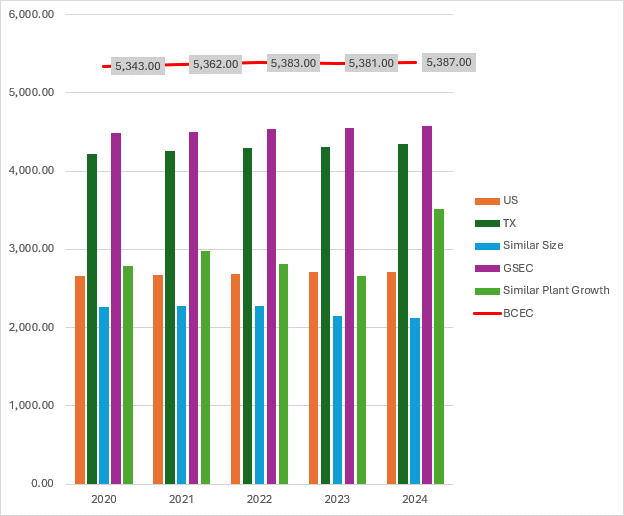
Key Ratio Trend Analysis—System Size and Member Density: Industry benchmarking data shows how rural electric systems differ from more densely populated utilities. BCEC maintains over 5,300 miles of line (KRTA Ratio 5) while serving about 2.5 consumers per mile (KRTA Ratio 125). Together, these metrics highlight the nature of rural electric service—more infrastructure is required to serve fewer members across a larger area. These are two of more than 145 KRTA metrics we track—along with utilities across the country—to help us evaluate system performance and manage the cost of delivering reliable power.
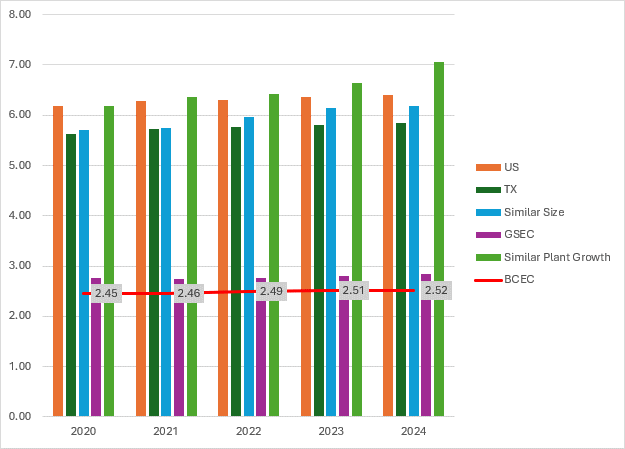
One of the biggest factors that shapes how electric systems are built, and what they cost to operate and maintain, is the distance between members in our service area. Electric cooperatives like BCEC serve large geographic areas with relatively few meters spread across many miles of line, a defining characteristic of rural electric service.
Your cooperative serves more than 6,000 members across more than 13,600 meters and over 5,300 miles of line, which averages to about 2.53 meters per mile of line. By comparison, more densely populated utility systems serve far more meters per mile, closer to 15–25 meters per mile or more in urban areas.
Industry benchmarking data, including metrics from the National Rural Utilities Cooperative Finance Corporation’s key ratio trend analysis, helps put this into perspective by showing how systems like Big Country EC’s compare to other electric utilities, as illustrated in the accompanying graphics.
Although nearby cooperatives in our region also fall within this lower-density range, most are still more densely populated than our service area, serving anywhere from three to eight meters per mile of line. This range highlights how much service territory and member density can vary across electric cooperatives in Texas. Even with these differences, the goal remains the same: making sure power is available when and where members need it.
For BCEC, that means delivering electricity to every member, which requires operating an extensive system of power lines across our service area. In more densely populated areas, more members share the cost of infrastructure. In rural areas like the Big Country, there are fewer members to share these costs.
This is the nature of rural electric service and one of the reasons electric cooperatives were formed: to bring reliable electricity to areas that were not economically feasible for other utilities to serve, with members sharing in the cost of building and sustaining the system.
Like many industries today, the cost of building and maintaining this infrastructure has increased in recent years. Materials such as poles, transformers and wire cost more, and equipment, vehicles, labor, fuel and construction costs have also risen. These are the same types of cost pressures families, farms, ranches and businesses are experiencing in their day-to-day operations.
For electric cooperatives, those rising costs are part of a larger responsibility to provide reliable service so power is available when members need it during peak demand, extreme weather and everyday use. That means balancing the cost of operating today with planning for the future.
At the end of the day, everything comes back to delivering reliable power to our members. As a member-owned cooperative, every decision we make is focused on keeping the lights on, keeping costs as low as possible and being mindful of our members’ pocketbooks along the way.